(003) Tab 2 - Supporting Statement - eMedical - 30-day PRA - 2025
(003) Tab 2 - Supporting Statement - eMedical - 30-day PRA - 2025.docx
Electronic Medical Examination for Visa or Immigration Benefit (eMedical)
OMB: 1405-0230
SUPPORTING STATEMENT FOR
PAPERWORK REDUCTION ACT SUBMISSION
Electronic Medical Examination for Visa or Immigration Benefit (eMedical)
OMB Number 1405-0230
DS-7794
A. JUSTIFICATION
Why is this collection necessary and what are the legal statutes that allow this?
The DS-7794 is used to record the medical information necessary to determine whether an alien seeking entry to the United States has a medical condition affecting his or her eligibility for a visa or immigration benefit.
The DS-7794 will be completed by panel physicians to report the medical condition of visa applicants; refugees; follow-to-join refugees and asylees; and certain parolees. The information requested includes the result of any diagnostic tests required for the diagnosis of diseases identified as communicable and of public health significance, as well as other evaluations identified as necessary to confirm a medical or other ineligibility under the Immigration and Nationality Act (INA) at INA § 212, 8 U.S.C. § 1182.
Pursuant to INA § 221(d), 8 U.S.C. § 1201(d), prior to issuance of an immigrant visa to any alien, a consular officer shall require such alien to submit to a physical and mental examination in accordance with such regulations as may be prescribed. Prior to the issuance of a nonimmigrant visa to any alien, the consular officer may require such alien to submit to a physical and/or mental examination, if such examination is deemed necessary to ascertain whether such alien is eligible to receive a visa.
INA § 207 and INA § 208, 8 U.S.C. 1157 and 1158, require medical screening of follow-to-join refugee and asylum applicants. INA § 412(b)(4)(B), 8 U.S.C. § 1522(b)(4)(B), further requires the United States government to “provide for the identification of refugees who have been determined to have medical conditions affecting the public health and requiring treatment.”
Under INA § 212(d)(5) [8 U.S.C. § 1182(d)(5)], the Secretary of Homeland Security (DHS) may use discretion to temporarily parole aliens into the United States for urgent humanitarian reasons or significant public benefit. Consular officers aid DHS in carrying out this function on a case-by-case basis by issuing boarding foils to these aliens after they receive an authorization memo from USCIS and complete required processing steps, which may include medical examinations. Some aliens paroled or seeking parole into the United States not issued a boarding foil are also required to undergo a medical examination under DHS and Secretary of Health and Human Services (HHS) authority to prevent the introduction, transmission, and spread of communicable diseases into the United States (42 U.S.C. § 264). The scope of the information required in the medical examination of an alien is defined at 42 CFR Part 34.
What business purpose is the information gathered going to be used for?
The business purpose of the DS-7794 is to allow panel physicians to complete the requirements for a medical examination and to communicate results to the Department of State (“Department”). A panel physician designated by the consular post performs the medical examination of the applicant and completes the forms in accordance with the technical instructions issued by the Centers for Disease Control (CDC).
The results determine whether a foreign national has a medical condition that renders the individual ineligible to receive the immigration benefit sought or a medical condition that, although not constituting a specific excludable condition, represents a departure from the normal health or well-being that is significant enough to interfere with the applicant’s ability to care for himself or to attend school or work, or that may require extensive medical treatment or institutionalization in the future.
Nonimmigrant visa applicants are not subject to the vaccine requirements in INA § 212(a)(1)(A)(ii); however, applicants for the K nonimmigrant visas are strongly encouraged to complete all required vaccines before traveling to the United States.
The Department uses the data obtained from the form to adjudicate applications for visas and other immigration benefits. CDC retains the information to match against U.S. arrival records and notify alien-receiving states when further health-related follow-up is necessary to protect Americans from disease. This process ensures newly arrived persons entering the United States do not pose a public health threat.
The information collected is retained in the Department’s systems. It is also provided to the CDC. The medical finding by the panel physician or the CDC, if referred to that agency, is binding on the consular officer in adjudicating the alien’s eligibility for a visa to enter the United States. Information collected in the DS-7794 may also be disclosed to any other U.S. government agency having statutory or other lawful authority to use such information for the purpose of law enforcement and immigration enforcement.
Is this collection able to be completed electronically (e.g., through a website or application)?
Yes, this collection is available electronically through the eMedical portal, which is available only to authorized panel physicians.
Does this collection duplicate any other collection of information?
Form DS-7794 is the online equivalent of the paper medical information collection (OMB Control Number 1405-0113), which contains forms DS-3025, DS-3026, DS-3030, and DS-2054. The separate information collections request identical information; however, panel physicians will only submit the results of a medical examination once, using either the paper or electronic version.
The DS-7794 is currently used exclusively for immigrant visa applicant examinations, while the examination results for nonimmigrant, K-visa, diversity visa, asylum, and follow-to-join refugee applicants are recorded through the paper medical forms. The Department is in the process of expanding the eMedical system to allow for its use for all aliens subject to medical examination prior to U.S. entry, but both collections are needed while the Department is transitioning away from the paper forms.
Does this collection impact small business?
This collection does not impact U.S. small business.
What are consequences if this collection is not done?
The Department has statutory obligations to assess the medical condition of certain aliens seeking entry to the United States, including immigrant visa applicants; refugees; follow-to-join refugees and asylees; and certain parolees. These obligations also extend to nonimmigrant visa applicants when a consular officer requests a medical examination to ascertain eligibility to receive a visa as outlined in INA § 221(d), 8 U.S.C. § 1201(d). Failure to complete the collection of this medical information would leave the Department unable to comply with federal law.
There is an information sharing agreement between CDC and the Department governing access to medical information received through this information collection. The CDC does not have a separate information collection that would allow for the screening of aliens seeking to enter the United States and as such, they rely on this collection to protect U.S. public health. Without the collection, there is an increased risk of communicable disease transmission domestically.
It is not possible to collect the information less frequently since up to date (confirmed less than 6 months prior) medical information is necessary to determine an individual’s health status and eligibility for a visa or immigration benefit.
Are there any special collection circumstances?
No. There are no special collection circumstances associated with this collection.
Did the Department solicit public comments on the collection?
The Department published a Notice in the Federal Register on 05/20/2025 to solicit public comments for a period of 60 days (90 FR 21536). The Department did not receive any responsive public comments in response to this Notice.
Are payments or gifts given to the respondents?
No. The federal government generally does not provide payments or gifts to respondents. Responding panel physicians are generally compensated by the aliens who must subject themselves to the required medical examination, with limited exceptions. Fees are agreed to in writing as part of a panel physician agreement.
Are any assurance of privacy/confidentiality provided to respondents?
In accordance with INA § 222(f), 8 U.S.C. § 1202(f), information obtained through this process is considered confidential and is only to be disclosed in certain circumstances enumerated in statute, including for use in the formulation, amendment, administration, or enforcement of the immigration, nationality, and other laws of the United States.
As assurance to panel physicians that they are protected from privacy-related liability while using eMedical to submit the DS-7794, aliens provide a written consent to the physician through the “eMedical Applicant Declaration.” Aliens are advised that their medical information will be temporarily stored in the eMedical system, which is hosted and maintained by the Australian Department of Home Affairs (Australia HA).
The eMedical system is protected by a certified “Secure Gateway Environment,” which is hosted by the Australian Defense Signals Directorate. The Gateway provides the necessary security controls to ensure information in the eMedical system remains private and confidential.
Are any questions of a sensitive nature asked?
Yes, the medical forms contain questions and fields which collect sensitive health and medical information. The questions in this information collection are necessary to determine whether an applicant is eligible for a visa under § 212(a)(1) of the INA, 8 U.S.C. § 1182(a)(1), among other grounds of ineligibility.
The sensitive questions are also necessary to determine whether refugees have medical conditions affecting the public and requiring treatment under INA § 412(b)(4)(B), 8 U.S.C. § 1522(b)(4)(B).
Additionally, the questions are needed to determine whether an alien can legally be issued a boarding foil for the purpose of parole, consistent with DHS policy under INA § 212(d)(5), 8 U.S.C. 1182(d)(5).
Aliens will be advised that the sensitive information collected from the medical examination may be accessible to other U.S. government agencies with statutory or lawful authority to use such information, including for law enforcement and immigration enforcement purposes.
What is the hour time burden and the hour cost burden on the respondent needed to complete this collection?
The Department estimates that approximately 696,000 aliens will be required to undergo a medical examination to receive an immigrant visa or immigration benefit each year. This is based on historical submission data for the categories of individuals who are subject to medical examination. An exam is valid for up to six months, after which, an individual may need to submit to a second exam. Aliens are advised to wait until after their consular appointment is scheduled before scheduling their medical examination with a panel physician. This works to ensure a valid medical exam is on file at the time of their appointment, avoiding the need for a repeat exam. Most aliens seeking to enter the United States will only be required to undergo a single examination, and as such, we do not account for duplicate exams.
Using current metrics, the Department estimates that of the 696,000 required medical examinations, panel physicians will submit approximately 550,000 through the eMedical portal. This number excludes responses for aliens who have historically been required to be processed using paper forms. After the Department transitions all cases to eMedical, the total number of responses to the DS-7794 will be equal to the annual estimate for all aliens subject to medical examination. The Department will submit updated burden figures after the process is complete.
There are approximately 800 panel physicians who are authorized to conduct these exams and provide the Department with the results. The Department estimates each medical examination takes approximately one hour to complete, which includes the amount of time a physician spends documenting the results on the form.
If each panel physician were to take an equal number of cases, the annual hour time burden for each respondent would be equal to an average 687.5 hours (550,000 responses * 1 hour per response / 800 physicians).
Form Number |
Time burden per response |
Estimated Annual Responses |
Total Annual burden hours |
Total annual Hour Cost Burden (@ $115/hour) |
DS-7794 |
1 hour |
550,000 |
550,000 |
$63,250,000 |
The hour cost burden per respondent is $79,062.50 (687.5 hours * $115 median U.S. hourly wage for physicians). The total hour cost burden is $63,250,000. However, it is important to note that physicians are, in fact, paid by the applicant for the time spent completing and submitting the medical forms, so there is no non-compensated burden imposed on the respondent.
What is the monetary burden to respondents (out of pocket costs) needed to complete this collection?
Respondents are panel physicians. Real monetary costs associated with examinations are considered “customary and usual business practices” in the respondent’s line of work, and these costs are not included when calculating PRA burdens. Respondents are also paid for costs related to conducting and communicating the results of the medical exam by those who are seeking a visa or immigration benefit. Therefore, the respondent out-of-pocket monetary burden is $0.
What are the costs incurred by the Federal Government to complete this collection?
The eMedical system hosts the DS-7794. In March 2017, the United States, as represented by the Department and CDC, signed on to an existing Multilateral Memorandum of Understanding (M-MOU) between Australia HA; Immigration, Refugees and Citizenship Canada; and Immigration New Zealand to participate in using the eMedical system. This agreement results in cost-savings for all M-MOU partners. Australia HA is exclusively reimbursed for costs of ongoing services and not for the purposes of financial gain or profit.
As part of the M-MOU cost-share agreement, CDC pays Australia HA the United States’ portion of the maintenance costs associated with the eMedical system. An interagency agreement (IAA) between the Department and CDC stipulates that the Department will reimburse CDC $289,847.61 annually, for its share of the eMedical services through July 2027 (FY 2026).
Any additional costs to the Department for processing this form are accounted for in the applicant’s corresponding visa application (e.g. DS-260 or DS-160).
Are there any changes/adjustments to this collection since the previous submission?
The Department is using program discretion to adjust the burdens associated with this collection. Previous iterations of this information collection request erroneously considered aliens seeking entry to the United States to be the respondents to this information collection. However, this is an inaccurate reflection of actual respondent burden, as the aliens do not fill out the forms. Only a panel physician is authorized to complete this information collection.
Because the respondents to this collection are exclusively panel physicians, the reported number of respondents drops to 800 (the approximate number of currently authorized panel physicians). The “Obligation to Respond” also becomes “Mandatory” with this adjustment, because completing the forms is required as part of the panel physician’s performance of the required medical examination.
The annual hour burden per respondent becomes approximately 687.5 hours with the adjustment. The corresponding cost burden per response also increases, as the average hourly wage for a family medicine physician is significantly higher ($115) than the average wage for all occupations ($31). The figures are derived from the U.S. Bureau of Labor Statistics (BLS) 2024 National Occupational Employment and Wage Estimates, and the Department acknowledges the average wage used in our estimate is much higher than real wages earned in foreign states for equivalent work.
The Department is also expanding the scope of the collection to allow eMedical processing for all aliens subject to a medical examination under the INA, including not only immigrant visa applicants but also certain nonimmigrant, follow-to-join refugee, diversity visa, asylum, parole, and K-visa applicants. Accordingly, the Department is updating the collection title from “Electronic Medical Examination for Visa Applicant” to “Electronic Medical Examination for Visa or Immigration Benefit (eMedical).” The new title will more accurately reflect the collection’s expanded scope.
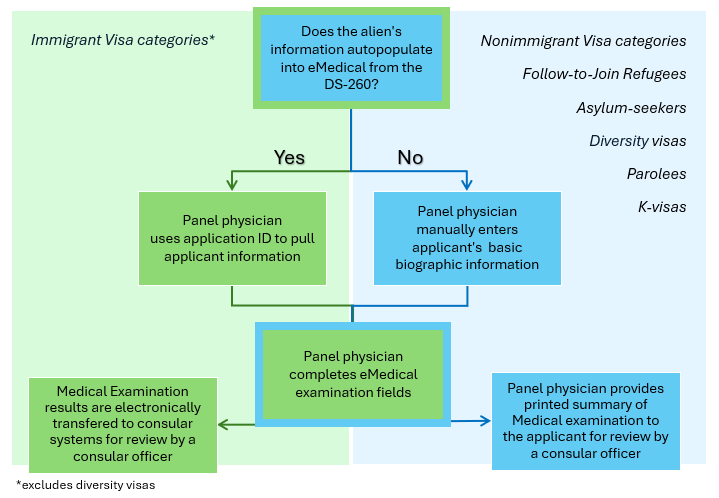
System limitations require the addition of an “upfront” section to manually record the basic biographic details of aliens who do not currently autopopulate into the eMedical system. Information fields requested in this new “upfront” section to the DS-7794 include name, sex, date of birth, location of birth, prior country of residence, nationality, identity documentation, and applicant category. The Department foresees no significant time burden change associated with the “upfront” fields. Additional system development will be required before it will be possible to autopopulate the information for all categories.
The information of aliens who file a DS-260 (Online Immigrant Visa and Alien Registration Application) autopopulates into the system, but all others do not. In the early stages of the transition to eMedical, the process for submitting information for the aliens which previously required paper medical examination forms will be different from the traditional eMedical process. The flowchart below provides an overview of how processing will work during the eMedical transition.
Will any data gathered by this collection be published?
No. The date gathered by this collection will not be published.
Will the OMB expiration date be displayed?
Yes. The Department will display the OMB expiration date on the collection.
Are any exceptions to the OMB certification statement being sought?
No. The Department is not seeking exceptions to the certification statement.
B. COLLECTION OF INFORMATION EMPLOYING STATISTICAL METHODS
This collection does not employ statistical methods.
| File Type | application/vnd.openxmlformats-officedocument.wordprocessingml.document |
| Author | Canfield, Danielle P |
| File Modified | 0000-00-00 |
| File Created | 2026-01-09 |
© 2026 OMB.report | Privacy Policy