Supporting Statement Part B -- HSOPS DB Renewal_6-9-25
Supporting Statement Part B -- HSOPS DB Renewal_6-9-25.docx
Collection of Information for AHRQ's Hospital Survey on Patient Safety Culture Comparative Database
OMB: 0935-0162
SUPPORTING STATEMENT
Part B
Collection of Information for
Agency for Healthcare Research and Quality’s (AHRQ)
Surveys on Patient Safety Culture Hospital Database
June 9, 2025
Renewal of the SOPS Hospital Survey Database
(OMB NO. 0935-0162; last approved on October 18, 2022;
Expiration October 31, 2025)
Table of contents
B. Collections of Information Employing Statistical Methods 3
1. Respondent universe and sampling methods 3
2. Information Collection Procedures 5
3. Methods to Maximize Response Rates 6
4. Tests of Procedures 7
5. Statistical Consultants 7
B. Collections of Information Employing Statistical Methods
1. Respondent universe and sampling methods
The AHRQ Surveys on Patient Safety Culture® (SOPS®) Hospital Database serves as a central U.S. repository for data from the survey. However, the database is comprised of data that are voluntarily submitted by hospitals that have administered the survey and is not a statistically selected sample of all U.S, nor is it a representative sample of all U.S. hospitals. Estimates based on this self-selected group may produce biased estimates of the population. Because of this, it is not possible to compute estimates of precision that apply to the population.
AHRQ developed and pilot tested the Hospital Survey on Patient Safety Culture with OMB approval (OMB NO. 0935-0115; approved on 2/4/2003). In 2019, an updated version of the survey, Version 2.0, was released on the AHRQ website (OMB 0935-0230, approved 01/21/2016). The SOPS Hospital Database was last approved on October 18, 2022 (OMB NO. 0935-0162; expiration date 10/31/2025).
Results from 445 hospitals that participated in the 2024 SOPS Hospital Database are available on the AHRQ website.1
According to the American Hospital Association (AHA), the number of hospitals in the U.S. is estimated to be 6,1932.The latest AHRQ SOPS Hospital Database Reports consists of data from 445 hospitals which represents only 7.2% of the total estimated population of U.S. hospitals.
Although the hospitals that voluntarily submitted data to the database do not constitute a statistically selected sample, the characteristics of these hospitals are fairly consistent with the distribution of hospitals registered with the AHA. The characteristics of database hospitals by bed size, teaching status, ownership, and geographic region are presented in the following tables and are compared with the distribution of AHA-registered hospitals included in the 2023 AHA Annual Survey of Hospitals2.
Table B-1. Distribution of Database Hospitals and Respondents by Bed Size
(Compared to AHA-registered U.S. Hospitals)
Bed Size |
AHA-registered U.S. Hospitals |
2024 Database Hospitals |
2024 Database Respondents |
|||
Number |
Percent |
Number |
Percent |
Number |
Percent |
|
6-24 beds |
900 |
15% |
51 |
11% |
4,183 |
1% |
25-49 beds |
1,429 |
23% |
81 |
18% |
11,863 |
4% |
50-99 beds |
1,197 |
19% |
60 |
13% |
18,371 |
6% |
100-199 beds |
1,189 |
19% |
72 |
16% |
35,637 |
13% |
200-299 beds |
591 |
10% |
63 |
14% |
48,422 |
17% |
300-399 beds |
355 |
6% |
37 |
8% |
44,628 |
16% |
400-499beds |
197 |
3% |
37 |
8% |
31,295 |
11% |
500 or more beds |
335 |
5% |
44 |
10% |
89,637 |
32% |
TOTAL |
6,193 |
100% |
445 |
100% |
284,036 |
|
Table B-2. Distribution of Database Hospitals and Respondents by Teaching Status
(Compared to AHA-registered U.S. Hospitals)
Teaching Status |
AHA-registered U.S. Hospitals |
2024 Database Hospitals |
2024 Database Respondents |
|||
Number |
Percent |
Number |
Percent |
Number |
Percent |
|
Teaching |
2,720 |
44% |
230 |
52% |
219,429 |
77% |
Non-Teaching |
3,473 |
56% |
215 |
48% |
64,607 |
23% |
TOTAL |
6,193 |
100% |
445 |
100% |
284,036 |
100% |
Table B-3. Distribution of Database Hospitals and Respondents by Ownership and Control
(Compared to AHA-registered U.S. Hospitals)
Ownership and Control |
AHA-registered U.S. Hospitals |
2024 Database Hospitals |
2024 Database Respondents |
|||
Number |
Percent |
Number |
Percent |
Number |
Percent |
|
Government (Federal or non-Federal) |
1,392 |
22% |
67 |
15% |
30,833 |
11% |
Nongovernment (not for profit) |
3,175 |
51% |
332 |
75% |
226,805 |
80% |
Investor Owned (for profit) |
1,626 |
26% |
46 |
10% |
26,398 |
9% |
TOTAL |
6,193 |
100% |
445 |
100% |
284,036 |
100% |
Table B-4. Distribution of Database Hospitals and Respondents by Geographic Region
(Compared to AHA-registered U.S. Hospitals)
Region |
AHA-registered U.S. Hospitals |
2024 Database Hospitals |
2024 Database Respondents |
||||
Number |
Percent |
Number |
Percent |
Number |
Percent |
||
Northeast |
781 |
13% |
74 |
17% |
73,124 |
26% |
|
South |
2,539 |
41% |
200 |
45% |
150,301 |
53% |
|
Midwest |
1,667 |
27% |
132 |
30% |
41,433 |
15% |
|
West |
1,206 |
19% |
39 |
9% |
19,178 |
7% |
|
TOTAL |
6,193 |
100% |
445 |
100% |
284,036 |
100% |
|
Note: Percentages may not add to 100 due to rounding. States are categorized into regions as follows: |
|
||||||
Northeast: CT, MA, ME, NH, NJ, NY, PA, RI, VT South: AL, AR, DC, DE, FL, GA, KY, LA, MD, MS, NC, OK, PR, SC, TN, TX, VA, VI, WV Midwest: IA, IL, IN, KS, MI, MN, MO, ND, NE, OH, SD, WI West: AK, AS, AZ, CA, CO, GU, HI, ID, MH, MP, MT, NM, NV, OR, UT, WA, WY |
|
||||||
Hospitals that submit data to the Database receive a free, customized feedback report that displays their hospital’s results against the aggregated and de-identified results of other hospitals submitting data to the Database. Hospitals that do not submit data to the database can still view the SOPS Hospital Database Report for aggregate results of those hospitals who voluntarily submitted their data to the Database. As part of a toolkit of support materials for the SOPS Hospital Survey, hospitals can also use a Microsoft® Excel-based Data Entry and Analysis Tool that is an Excel file with macros that will automatically produce graphs and charts of a hospital’s results once data are entered in a data sheet. Many hospitals use this tool to produce their results.
In the overall database report, hospitals are provided with a detailed description and explanation of the statistics that are presented and given examples and guidance on how to calculate their own scores for comparison.
2. Information Collection Procedures
Information collection for the AHRQ SOPS Hospital Database occurs in a periodic data collection cycle approximately every two years in June. The next submission period is June 2026. Information collection procedures for submitting and processing data are shown in Figure 1.
Figure 1. SOPS Hospital Database Data Submission
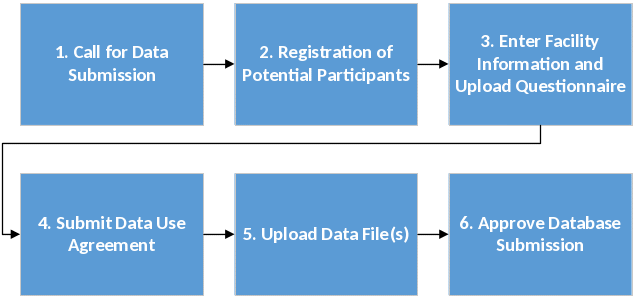
Step 1: Call for Data Submission. Announcements about the opening of data submission go out through various publicity sources. AHRQ’s News Now and patient safety electronic newsletters target approximately 191,000 and 120,000 subscribers respectively. In addition, the AHRQ Surveys on Patient Safety Culture listserv targets approximately 79,400 subscribers. An example of email announcements calling for data submission is shown in Attachment D, Email # 1 and # 3. Through these efforts, U.S. hospitals are made aware of and invited to submit their survey data to the database.
As the administrator of the database and under contract with AHRQ, Westat provides free technical assistance to submitting hospitals through a dedicated email address (DatabasesOnSafetyCulture@westat.com) and toll-free phone number (1-888-324-9790).
Step 2: Eligibility and Registration for Potential Participants. A secure data submission website allows interested parties, such as hospitals and health systems, to register and submit data. Registration takes about 3 minutes to complete and asks for contact and basic information (see Attachment A). After registering, if registrants are deemed eligible to submit data, an automated email is sent to authenticate the account and update the user password (see Attachment D, Email #2).
Once users are registered and have a password, they can enter the main page menu of the website. Information about eligibility requirements, data use agreements, and data file specifications regarding how to prepare their data for inclusion in the SOPS database is posted and can be reviewed.
Step 3: Enter Hospital Site Information and Upload Questionnaire. At this step, users provide information about each of their hospitals, such as Medicare Provider ID, AHA ID, point of contact, method of survey administration, number of surveys distributed and completed, and--if they do not have an AHA ID--other facility characteristics (e.g., bed size, teaching status, geographic region, and ownership) (see Attachment B). They also upload their survey questionnaire that they administered to enable us to determine whether any changes were made to the survey (see Attachment G, Figure 1).
Step 4: Submit Data Use Agreement (DUA). To protect the privacy of all participating hospitals, a duly authorized representative from the hospital must sign a Data Use Agreement (DUA) (see Attachment C). The DUA language was reviewed and approved by HHS’s general counsel and asserts that the hospital’s data will be handled in a secure manner using necessary administrative, technical and physical safeguards to limit access to it and maintain its confidentiality. In addition, the DUA explains that the data are used for the purposes of the database, that only aggregated results are reported, and that the hospital will not be identified by name. Data are not included in the database without this signed DUA. Users can fax, mail, or upload a copy of the signed agreement.
Step 5: Upload Data File(s). At this step, users are asked to upload their individual-level survey data for each hospital (see Attachment G, Figure 2). Data submitted through the secure data submission website are encrypted to ensure secure transmission of the survey data. Data are accepted in Microsoft Excel® format since this is the format preferred by hospitals. Users must upload one data file per hospital. If a user has multiple hospitals within a health system, users can upload one data file that identifies all the hospitals in their system. The data file specifications (see Attachment E) are provided to data submitters to ensure that users submit standardized and consistent data in the way variables are named, coded, and formatted.
Once a data file is uploaded, a separate load program developed in Visual Basic (VB) reads the submitted files and loads them into the SQL database that stores the data. A data quality report is then produced and made available to the participant. This report displays item frequencies and flags out-of-range values and incorrectly reverse-coded items. If there are no problems with the data, an acknowledgement of data upload and acceptance will be granted during the user session. If data are improperly coded, the user is informed by having a message post on the screen indicating that the data file failed. Users are expected to fix any errors and resubmit their data file(s) for processing. Once there are no problems, the user is informed of the acceptance of data during the user session with an online message of acceptance.
Step 6: Approve Data Submission. Once all the information required for submission has been submitted and approved, an email is sent to the hospital contact indicating that their data have received final acceptance.
3. Methods to Maximize Response Rates
AHRQ makes a number of toolkit materials available to assist hospitals with the SOPS surveys. The SOPS Hospital Survey has a Survey User’s Guide that gives users guidance and tips about survey administration on the following topics: planning; selecting a sample; determining their data collection method; data collection procedures (including a section on web surveys); and analyzing data and producing reports3. The Survey User’s Guide also gives hospitals tips about how to increase response rates through publicity efforts, top management support, use of incentives, and following all steps of proper data collection protocols. Of the hospitals that voluntarily submitted their data for the 2024 SOPS Hospital Database, the average response rate was 52% across the 445 hospitals.
The SOPS User Network promotes the database to encourage data submission in a number of ways:
AHRQ and AHRQ SOPS email listservs;
Organizational partners and stakeholders that have national reach to hospitals;
Users that have contacted the SOPS technical assistance helpline about the hospital survey;
Other outlets such as webcasts and conferences.
As noted earlier in this document under Information Collection Procedures, Step 1 – Call for Data Submission, announcements about the opening of data submission go out through various publicity sources as a way to boost hospital participation in the database. AHRQ, through its contractor Westat, provides free technical assistance to users through a dedicated email box and toll-free phone number. In addition, reminders are sent to database registrants to remind them of the deadline for data submission.
4. Tests of Procedures
Input and Feedback for the Development of the SOPS Database Submission System. Because the Surveys on Patient Safety Culture are public-use instruments, the SOPS program has generally modeled its data submission processes after those utilized by the Consumer Assessment of Healthcare Providers and Systems (CAHPS) Database that has been in operation for many years. SOPS staff consulted with CAHPS Database staff and programmers to determine best practices for data submission. This information, as well as feedback obtained during the provision of technical assistance each year the database has been running, has been used to improve the SOPS online data submission system and process over time.
5. Statistical Consultants
Joann Sorra, PhD
Westat
1600 Research Blvd.
Rockville, MD 20878
Naomi Yount, PhD
Westat
1600 Research Blvd.
Rockville, MD 20878
1 SOPS Hospital Database. Content last reviewed November 2024. Agency for Healthcare Research and Quality, Rockville, MD. https://www.ahrq.gov/sops/quality-patient-safety/patientsafetyculture/hospital/hosp-reports.html. Last accessed 3/5/25.
2 Data for U.S. and U.S. territory AHA-registered hospitals were obtained from the 2023 AHA Annual Survey of Hospitals Database, © 201+ Health Forum, LLC, an affiliate of the American Hospital Association. Hospitals not registered with AHA were asked to provide information on their hospital’s characteristics, such as bed size, teaching status, and ownership.
3 Hospital Survey on Patient Safety Culture. Content last reviewed July 2024. Agency for Healthcare Research and Quality, Rockville, MD. http://www.ahrq.gov/professionals/quality-patient-safety/patientsafetyculture/hospital/index.html Last accessed 3/5/2025
| File Type | application/vnd.openxmlformats-officedocument.wordprocessingml.document |
| File Title | SUPPORTING STATEMENT |
| Author | wcarroll |
| File Modified | 0000-00-00 |
| File Created | 2026-01-07 |
© 2026 OMB.report | Privacy Policy